
A trailer can be stolen in minutes. Establishing exactly what it is, where it came from and who it belongs to can be much harder.
That distinction matters.
As trailer theft continues to create financial losses for owners and insurers, and stolen assets can enter the second-hand market, effective security needs to do more than make theft difficult. It also needs to help establish an asset's identity if it is stolen, recovered or offered for resale.
The latest analysis from The Equipment Register (TER) found that 11% of checks on used horseboxes and trailers were associated with theft, fraud or another financial irregularity. This is equivalent to around one in nine checks, up from one in ten checks in 2025.
TER says its database now contains more than 1.8 million items, highlighting the scale of the second-hand equipment market and the importance of establishing an asset's history and identity before purchase.
For legitimate buyers, identification is an important part of that process. For owners whose trailers are stolen, it can become even more significant.
The financial consequences are substantial. According to NFU Mutual's 2025 Rural Crime Report, trailer theft accounted for an estimated £1.3 million in claims during 2024, an increase of 15% compared with the previous year.
And the impact is not limited to the value of the trailer itself. Theft can mean lost working time, disruption to businesses and additional costs associated with replacement and recovery.
Recent police activity also demonstrates that trailers can be deliberately targeted. In March 2026, West Mercia Police investigated a series of seven trailer thefts across Worcestershire and Herefordshire in a matter of weeks. Police said they believed organised crime groups were targeting trailers for onward sale. Some of the stolen trailers were subsequently recovered and two men were arrested.
The cases demonstrate a wider challenge: preventing theft is important, but so is being able to identify an asset when it is recovered.
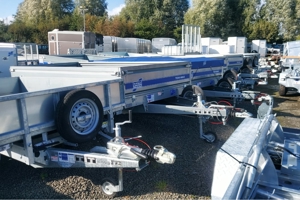
Locks, wheel clamps, alarms and trackers all have an important role to play in protecting trailers.
But no single security measure addresses every stage of the theft cycle.
A determined thief may overcome physical security. A stolen trailer may be moved away from its original location, stripped of obvious identifiers or presented for resale. That is where asset identification becomes an important additional layer of security.
The question is no longer simply:
“How do we make this trailer harder to steal?”
It is also:
“If this trailer is stolen, how do we make it harder to disguise, sell or permanently separate from its identity?”
Effective trailer security should work across the asset's lifecycle, from manufacture and sale through ownership, theft and potential recovery.
At VIN Chip, this is the principle behind a layered approach to forensic security marking and asset identification. It combines different technologies and identification methods so that a trailer can remain identifiable even if visible markings are removed or altered.
Tamper-evident warning labels make the presence of security marking clear and can act as a visible deterrent to opportunistic thieves.
Microdots and forensic marking provide additional identification beyond what can be seen on the surface. This creates another means of establishing an asset's identity when conventional markings may no longer be sufficient.
Encrypted UHF RFID provides a further identification layer that can be read at distance using compatible equipment, without requiring a battery in the tag.
The technology is supported by secure asset registration, creating a record that can help establish the identity and registered keeper of an asset when identification is required.
The value is not in one technology alone. It is in creating an identification ecosystem around the asset.
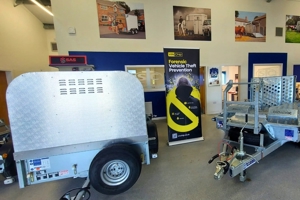
The importance of identification is demonstrated by real police experience.
Following VIN Chip training with Kent Police on identifying plant machinery and equipment, including Ifor Williams trailers, PC Amy White used that knowledge on her very next shift to identify a stolen trailer. The trailer was subsequently recovered.
It is a practical example of why identification should not be treated as an afterthought. When officers know what to look for and an asset has multiple layers of identification, the chances of establishing what that asset is can be strengthened.
Trailer security is not only an issue for the end user.
For manufacturers and dealers, it creates an opportunity to make security part of the ownership proposition from day one rather than leaving customers to consider security only after a theft has occurred.
Integrating identification into the asset lifecycle can provide customers with an additional layer of protection while giving manufacturers and dealers a stronger security proposition to discuss at the point of sale.
It also reflects a broader shift in the way valuable assets are being protected. Security is no longer simply about preventing unauthorised access. It is increasingly about deterrence, identification, traceability and recovery working together.
As the second-hand trailer market continues to present identification challenges, the industry has an opportunity to think differently about security. Physical protection remains essential. But for valuable trailers, security can go further.
By combining visible deterrence, covert forensic marking, long-range identification and secure registration, owners can add layers of protection designed to help deter theft and support identification if an asset is stolen or recovered.
At VIN Chip, our focus is on giving valuable assets a permanent identity, helping manufacturers, dealers and owners take a more complete approach to trailer security.
Because protecting a trailer shouldn't end when it leaves the yard.
Find out how VIN Chip's forensic security marking and asset identification solutions can add another layer of protection to your trailer.
Related Story

VIN Chip Training with Kent Police Leads to Immediate Stolen Trailer Recovery
Learn how VIN Chip’s expert training with Kent police led to the rapid recovery of a stolen trailer and empowered officers to combat machinery theft more effectively.




Privacy
Find us
VIN Chip Ltd,
Catherine House,
Victoria Road,
Aldershot,
Hampshire,
GU11 1SS
VIN Chip Ltd, Catherine House, Victoria
Road, Aldershot, Hampshire, GU11 1SS
Certifications, Memberships and Awards


